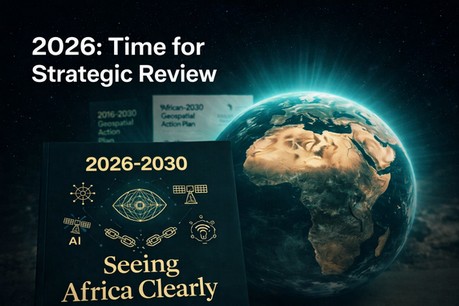
Pourquoi l’Afrique a besoin d’une révision ambitieuse du Plan d’Action 2016-2030
Quatorze ans après l’adoption du Plan d’Action Africain sur la Gestion de l’Information Géospatiale pour le Développement Durable (AAP-GGIM / GI4SD 2016-2030), l’Afrique se trouve à un tournant décisif.
La 12ième Réunion du Comité Régional UN-GGIM: Africa (octobre 2026, Addis-Abeba), sous présidence marocaine, offre une opportunité historique de revisiter et d’actualiser ce cadre stratégique.
Le rapport State of Geodesy 2026 a révélé une maturité globale faible du système géodésique international, avec une gouvernance et un financement particulièrement critiques.
Parallèlement, les avancées des cadres IGIF et FELA, et l’essor fulgurant de l’Intelligence Artificielle Géospatiale (GeoAI), avec des incidents récents comme la désactivation soudaine des modèles Anthropic (juin 2026) soulignent les vulnérabilités liées à la dépendance technologique extérieure.
L’Afrique ne peut plus se contenter d’un plan adopté en 2016 dans un monde profondément transformé par les technologies numériques et l’intelligence artificielle.
Nous appelons donc à l’élaboration urgente d’un nouveau Plan d’Action Africain qui place au cœur de ses priorités en réponse notamment aux recommandatioss de le CoM 58 à Tanger:
- La souveraineté des données et la souveraineté algorithmique ;
- Le renforcement significatif de la contribution africaine à la Chaîne Globale de Géodésie (notamment via AFREF) ;
- L’adoption responsable et accélérée de solutions GeoAI adaptées aux réalités africaines ;
- Une intégration renforcée entre information géospatiale et statistique ;
- Des mécanismes innovants de financement durable et de partenariats public-privé ;
- Le développement inclusif des capacités humaines, avec un accent particulier sur la jeunesse et les femmes.
La révision de ce Plan d’Action n’est pas une simple mise à jour technique. Elle constitue un acte de souveraineté stratégique pour permettre à l’Afrique de transformer son intelligence spatiale en levier de développement durable, de résilience et d’autonomie.
La 12 ième réunion UN-GGIM: Africa doit marquer le lancement officiel de ce processus de révision ambitieuse.
Ma contribution sera sous la forme de six billets, que je vais publier sur cette plateforme en relation avec les thématiques précitées.
Références
https://www.uneca.org/eca-events/sites/default/files/resources/documents/com/2026/2600301f.pdf
https://www.uneca.org/eca-events/sites/default/files/resources/documents/com/2026/2501296f.pdf
Towards a Renewed African Action Plan on Geospatial Information
Why Africa Urgently Needs a Bold Revision of the 2016-2030 Action Plan
Fourteen years after the adoption of the African Action Plan on Geospatial Information for Sustainable Development (AAP-GGIM / GI4SD 2016-2030), the continent stands at a critical juncture. The upcoming 12th Meeting of UN-GGIM: Africa (Addis Ababa, October 2026), under the Moroccan Presidency, offers a historic opportunity to review and update this strategic framework.
The State of Geodesy 2026 report has exposed significant weaknesses in the global geodetic ecosystem, particularly in governance and financing.
At the same time, the evolution of IGIF and FELA frameworks, the rapid rise of Geospatial Artificial Intelligence (GeoAI), and recent events such as the sudden global deactivation of Anthropic’s advanced models (June 2026) highlight the growing risks of technological and algorithmic dependence.
Africa can no longer rely on a 2016 Action Plan in a world profoundly transformed by digital technologies and artificial intelligence.
We therefore call for the urgent development of a new African Action Plan that prioritizes:
- Data sovereignty and algorithmic sovereignty;
- A significantly strengthened African contribution to the Global Geodesy Supply Chain (particularly through AFREF);
- Responsible and accelerated adoption of GeoAI solutions tailored to African realities;
- Deeper integration between geospatial and statistical information;
- Innovative and sustainable financing mechanisms, including strengthened public-private partnerships;
- Inclusive human capacity development, with special focus on youth and women.
The revision of this Action Plan is not merely a technical update. It represents a strategic act of sovereignty to transform Africa’s spatial intelligence into a powerful driver of sustainable development, resilience, and autonomy.
The 12th UN-GGIM: Africa Meeting must mark the official launch of this ambitious revision process.
My contribution will be in the form of six posts, which I will publish on this platform in relation to the aforementioned themes.